Showing posts with label math. Show all posts

Thursday, July 23, 2009

A meditation on Archimedes to satisfy the needy


Why Archimedes is Awesome

  • Started calculus
  • Made the best estimate of pi up to that time
  • Was completely in love with math


Archimedes has always been a figure who impressed and intrigued me. I got an opportunity in 11th grade to really explore him and that led me to writing an essay on him and the depth of his love of math. His life is a model of beautiful passion, something we are all capable of but which many of us are afraid to explore.

Eureka!
An essay for American Literature class


Written 1/1/02

Few men have understood the glory of living. Thorton Wilder calls those few “poets and saints.” While not all poets and not all great men truly understand this glory, some understand and that is what compels them to do great things. They understand that every moment is worthwhile, that the grimmest part of life is still life and is still beautiful. Most will never have that understanding, most understand only after they can look back on their entire life, and that can only happen at death. “It takes life to love Life,” Edgar Lee Masters once wrote. And for most that is true, but for a very few, understanding comes naturally and it makes them glorious. One of these great men was Archimedes1 of Syracuse. He was an ancient Greek mathematician, considered to be one of the three greatest mathematicians of all time2 (Golba, online). He revolutionized math in the ancient world and his contributions directly inspired new discoveries more than a 1000 years after his death. The elegance and beauty of math and pure logic amazed him. He was always contemplating the magnifigance of the universe in his symbols and numbers. He loved truth, understanding, and figuring out things. Math was his passion and he served his passion well (O’Connor and Robertson, online). Archimedes will always be remembered, because he could connect a grain of sand with the universe, and figure the mind of God plus or minus a sin function. Archimedes understood the beauty of life and that made him a very great man.

Archimedes was born around the year 287 BC. His father, Phidias, was a Greek astronomer, and he raised him in a house of math (Bendick 1). His city was Syracuse, a major city on Sicily, and a bustling seaport. He was likely related to the king of Syracuse, King Hiero II (Rorres, online). This suggests that he was moderately wealthy and so it’s not surprising he had enough to travel to Alexandria to study math in all its shapes and forms (Bendick 24). Math as a science was just beginning (Benedick 16). However, it was growing and mathematicians were gathering their information together in Alexandria; thus started for the first time a mathematical community (Bendick 26). Archimedes joined this community and dug in to every field he could. This was the beginning of Archimedes’ long and amazing career in math. He began sending out work to his colleages and gained a reputation for being top-notch. He eventually left Alexandria, leaving behind a considerable legacy including the Archimedes screw, an irrigation device (O’Connor and Robertson, online). He returned to Syracuse, but his math work did not stop. He became an expert engineer, revolutionizing the field of the lever, creating pulleys upon pulleys upon pulleys, and building some of the largest catapults the world had ever seen. He even once created, some say, a reflective mirror that burned enemy ships (Rorres, online). Most of his inventions went straight to the war room where King Hiero and his successors used them in Syracuse’s ongoing wars with Rome, a power just beginning to bloom (Golba, online). Archimedes’ inventions3 saved Syracuse the initially from a powerful seige, but Syracuse was taken by a suprise attack by Rome and was conquered (Rorres, online). Archimedes died when Rome took over Syracuse, killed by a soldier, despite orders that said to spare the mathematician’s life (Bendick 128).

While Archimedes was known for his inventions, that wasn’t his field of choice (Golba, online). His greatest works were in the fields of arithmetic, geometry, and physics. Nine of his works have survived, On plane equilibriums (two books), Quadrature of the parabola, On the sphere and cylinder4 (two books), On spirals, On conoids and spheroids, On floating bodies (two books), Measurement of a circle5, The Method, and The Sandreckoner. It is known that he did much more; his name is used in many, many works of his contemporaries and his successors. He developed the basis of integral calculus, he examined every geometric shape from the spiral to the circle. And yet Archimedes also treasured the ideas of others, using some of the newest of the time, like the sun-centered universe6 (O’Connor and Robertson, online). He loved ideas and the truth. Archimedes went far beyond just proving new math to be true, he wrote his methods down for the ages, and he also invented a new numeral system to express numbers that Greek numerals couldn’t. This number system came in handy when Archimedes calculated the number of sands of grain needed to fill the universe7, or at least the concept of the universe at the time (O’Connor and Benedict, online). This was not practical but it was a work of love, for Archimedes truly treasured the order and logic of the universe through math.

Archimedes’ art was math and he loved his art. Yet math is not an art of creation, it is an art of discovery. The laws of math have been true since the beginning of existence and Archimedes reveled in them. He would go without eating, start scribbling while bathing, writing down math as fast as he could. If he could ever find a surface to draw upon, even if it was simply the dirt with a twig he would start drawing figures (Golba, online). In the end these figures led to his death. Accounts of his death8 claim that he was scribbling math in the dust during the invasion of Syracuse when he was confronted by a Roman soldier, he told the soldier “don’t disturb my figures” and the enraged soldier killed him (Rorres, online). Archimedes was in such rapture about the joys of discovering new truth that he did not noticed the burning of his city around him. He did love his city and gave it some of his finest inventions, but math was his true love and so he could not waste time fretting over a city when the secrets of the universe were at stake. It was through this love that he loved life. He found that the universe had in it unlimited wonder and was continuously trying to find that wonder through math. His love of math was his love of life, his math was but an expression of life’s logic. Archimedes worked to his last moment, savoring every second, and then died forever a mathematician in love with the order of the universe.

Archimedes lived a life of math. Being a mathematician was nothing special especially with an astronomer for a father. Yet he is the greatest of all the mathematicians of antiquity, perhaps of all time. He figured out the relationship between the volumes of a sphere and a cylinder, he figured out the workings of water displacement, he understood the secrets of conics and a great deal more (Rorres, online). He was great, but what drove him was a love of math. This love of math was a forever wonder about the mysteries of life, and in this way Archimedes understood life.

1-Archimedes was his full name, most Greeks only had one name (Bendick 1)

2- The other two are Newton and Gauss (Golba online)

3-In addition to the inventions already mentioned Archimedes employed a large metal contraption that would rake ships at sea, he also booby traped the walls of Syracuse (Rorres, online)

4-This work concerned the ratio between the two and Archimedes requested that ratio be engraved on the door of his tomb (Golba, online)

5-In this book he calculated the most accurate pi at the time (Bendick 91)

6-Archimedes used the universe constructed by his father, Eudoxus, and Aristarchus, (O’Connor and Robertson, online). He later made a mechanical model of this universe that lasted 200 yr.s (Benedict 78)

7-the number of grains needed to fill the universe is approximately 8*10^16 (O’Connor and Robertson, online)

8-One account says he was carrying mathematical equiment that looked like gold and that is why he was killed (Rorres, online)

Works Cited


Bendick, Jeanne. Archimedes and the Door of Science. Warsaw, North Dakota: Bethlehem Books. 1995.

O’Connor, J. J., Robertson, E. F. “Archimedes of Syracuse.” January, 1999. University of St.Andrews. Online. Internet. Dec 21, 2001.

Golba, Paula. “Archimedes.” 1994. Interactive Real Analysis, ver. 1.9.3. Online. Internet. Dec 21, 2001.

Rorres, Chris. “Archimedes Home Page.” 1995. Drexel University. Online. Internet. Dec 21, 2001.

Good Archimedes links


Good overview

Lots of info

A Good starter

Archimedes writings

Monday, May 4, 2009

Archimedes Rules!!! Woo!!!

Imported from Mathimoto's Complaint (a failed blogging venture that nonetheless produced some good work):
I'm not a Hellenophile, I have a good taste for the Classics mind you, but I'm not one of those who say the Greeks invented everything. With Math, for example, despite the immense Greek influence (often not done by actual Greeks but by Egyptians or Syrians who spoke Greek), but India, Arabia, and China also had a huge impact on the history of Math. And yet, there is one Greek, who's outstanding enough that I can never get tired of hearing about him.

ARCHIMEDES!!!

So we have a man who created ancient war machines that matched even the Romans for years. Yet despite the mountains of gold that earned him, the war machines were a distraction. His love was Math. Pure Math. And it was there he performed miracles. Mechanics of Floating Objects. Combinatric speculation. Areas of curves and spheres. And the number of grains of sands that it would take to fill up the universe.

He was so high up the math ladder he had to invent his own number system. He dabbled with the basics of integral calculus and said that they weren't rigorous enough for him.

And the man doesn't stop giving. The Archimedes Palimpsest, the best collection of Archimedes writings despite being buried under layers of rewritten parchment, has never been in the best condition, having been mold encrusted, painted over, and scraped apart. Yet with a little patience, a little hard work, and some ultra-fancy X-rays, the Palimpsest is still giving up new texts by, about, or unrelated to Archimedes. As late as April 2007, a new commentary about Archimedes was discovered.

Check out more info about the Archimedes Palimpsest.

Friday, July 11, 2008

We're all quadratics too

So let's do it as they do it in the quadratic formula.

Behold:

x = (-b +/-b2 - 4ac)/(2a)


Now Mathimoto's Complaint aims to cover a wide range of fans of math and today I'd like to reach out to the younger crowd. That precious younger crowd undoubtedly have seen the beauty of the quadric equation. But they and probably some older folks as well have never given an effort at deriving it. Well, I thought I'd give it a shot and show you the awesomeness of figuring out these formulas. Because Math rocks, it really does.

First start out with the generalized form of a basic quadratic equation (ie any equation with 1 variable (let's say x) and some instance of that variable raised to power 2 and possibly some instance of that variable raised to power 1. Okay, so it was harder to describe things rather than write it out, so let's do that)

Let a, b, and c be constants and x be a variable.

A basic general quadratic equation is:

ax2 + bx + c = 0


Now it helps then to know one particular quadratic equation, that is what happens when you have

(x + b)2 = 0

this can be expanded to

x2 + 2bx + b2 = 0


(Don't believe me, just use the distributive property of multiplication, ie,

(x+b)2 = (x + b)(x + b) =

x (x + b) + b (x + b) = x2 + bx + bx + b2 =

x2 + 2bx + b2

Ta-da)

Okay, now if you got a quadratic equation of the form

x2 + 2bx + b2 = 0


And you know

(x + b)2 = x2 + 2bx + b2

You can then say

(x + b)2 = 0

and with an equation like that, the only time you have a number that can match the value of x (and still give you 0, ie, the solution of the equation) is

x = -b


Back to the general basic quadratic equation:

ax2 + bx + c = 0


At this point we don't know how to find the solution value of x here, but since we know the solution for

(x + b)2

we can reconfigure our general equation to fit our particular equation. Just follow along.

If

ax2 + bx + c = 0

then we can play around with this, our goal equation doesn't have a c, so let's just subtract it from both sides.

ax2 + bx = -c

Well, our target equation doesn't have an &lsquot;a&rsquot; so let's get rid of the a by dividing it from both sides.

x2 + bx/a = -c/a

Okay let's remember our target equation (or the essentials of it)

(x + b)2 = x2 + 2bx + b2

now let's make a little pretending. Let's say instead that the b in our target equation is really say some other letter, say d. Then:

(x + d)2 = x2 + 2dx + d2

And if the current state of our manipulation of the general equation is:

x2 + bx/a = -c/a

we can get to our target a little easier if we say that

d = b/2a

alright now let's take it up a notch by throwing in the new d, then we get

x2 + 2dx = -c/a

well now all we need is the d2 and we can just add that to both sides, so:

x2 + 2dx + d2= -c/a + d2

Well, we can use our old target equation:

(x + d)2 = x2 + 2dx + d2

to simplify this:

(x + d)2= -c/a + d2

Now remember, with a situation like this, the name of the game is find the x, and currently our x is trapped in a term that's raised to a power, so let's get rid of that with a little friend called the square root (but remember that with real square roots you have a positive root and a negative root, since the negative goes away from the squaring).

x + d = +/-d2 - c/a

Now, now, now, we can FIND THE X (by subtracting d from each side)

x = -d +/-d2 - c/a

now just one more step to define the x in the a, b, c constants we started out with, just reverse the d insertion with our

d = b/2a

and we can get...

x = -b/2a +/-(b/2a)2 - c/a

so there we go, we've found the x, but it's kind of ugly so let's simplify things a little by doing some expansion and some common denominator and essentially simple algebra which I'm going to skim over a little:

x = (-b +/-b2 - 4ac)/(2a)


And there we go, we've got the quadratic formula! Yaaaah!!!! Behold it and be amazed!!!

x = (-b +/-b2 - 4ac)/(2a)


MATH RULES!!!! WOOOOO!!!!

Wednesday, July 9, 2008

Mathimoto's Revamp

As things have suggested Mathimoto is still doing changes of many types. First I have added good old Robo-Bobo as my partner, and now I'm doing some redesign of the layout and such. So prepare yourself, for awesomeness, brought forth through the power of MATH!!!

Thursday, July 3, 2008

lots of change = good, net-wise at least

So good old Mathimoto has been going through some changes, and with these changes has come much busy-ness, but do not fret! The math continues, and indeed will improve...

For example, soon this blog will utilize the very useful technology of math markup languages. Which exactly, I'm not sure at the moment, but it will be done! And then you'll have nice little graphics here with all the equations and such.

But perhaps most dramatically, joining the crew will be segments by Mathimoto's good friend, a robot-man whose name escapes me at the moment (if he was a kill-bot I would be much scared by this development but fortunately he is not).

Now this blog was initially envisioned as a math blog above and beyond CS, but this is also a blog on the internet so it is natural that CS developments be of some concern. Yet do not fear, the math will not be enveloped, and to protect the math, Mathimoto's posts and his robot friend's will be kept separate. The math will go on!

Because Math rules!

Friday, June 6, 2008

Mathimoto's Real Complaint

My real complaint is I haven't been able to post more.

Alack, alack, alack. And the real victims are you good folk. But even Mathimoto needs a job, and rest assured once the job situation is stabilized, posts will come once more!!!

But in lack of that, let me give you a little play with number, related by the way, to some secret math speculation I'm doing.

If you want to find if a number is divisible by:

2, check if it's even. (Simple enough)

3, add all the digits and see if the sum is divisible by 3, if it is then the actual number is divisible by 3. (That's one of the cooler tricks)

4, if the last two digits are divisible by 4, then the whole thing is divisible by 4.

9, add the digits, and if the sum is divisible by 9, then the actual number is divisible by 9.

Do you see the suggestion here? Maybe there's a relation between numbers and their base 10-representation. Maybe... and maybe I'm getting close to it... maybe...

But what we do know for sure (to quote my good friend Kendrick), is that numbers are awesome.

NUMBERS RULE!!!!!!!!!
WOOOOO!!!!!!!!

Sunday, June 1, 2008

Let me hear you say math... MATH!!!

A friend of mine once noted that it's a shame that math theory is becoming too complicated for normal people to play with.

But I don't think that it's a necessity, I think mathematicians just accept that this is the way the world must be, and thus refuse to take any effort to simplify mathematical theory.

And perhaps more importantly, new areas in math theory which might be more accessible to amateur innovation aren't being explored as vigorously as they should, largely because mathematicians are starting to forget what math is really about...

Playing with numbers.

Because numbers rock.

In that spirit, look at a list of squares
1
4
9
16
25
...

If you look at the differences between consecutive squares, you'll see a pattern and if you play with that pattern a little, you get...

n^2 = Sum from i=1 to n (2i - 1).

Think about it...

Tuesday, May 27, 2008

Primes, they aren't just for Transformers

It has to be said.

There is just something magical about primes.


I mean they are numbers that represent something basic. Multiplicatively, they can't be broken down and they end up becoming the special cases upon which every mathematical theory must be tried. And yet once you throw them into the world of math theory you get all sorts of weird math facts, that are just undeniably cool.


Like the fact that (p-1)! + 1 is divisible by p, if and only if, p is a prime.


Dude, like awesome.


And yet primes remain mysterious. It was only a few years ago people learned how to test if a number was prime within polynomial time (see here), people still can't prove that there are an infinite number of primes where p and p+2 are prime. And there's the fact that as you go to infinity, the number of primes approaches the function x/ln(x). Zuh?!


I say zuh not because prime numbers are hard to understand, although sometimes they are, but because their wonder and bounty are just mind-boggling.


So let it be understood then, primes are awesome.


And since primes are awesome, math is awesome.


Of course, this is but one of the proofs of math's awesomeness, which are as numerous as prime numbers themselves, and thus proven to be infinite.

Tuesday, April 8, 2008

Tiding over the Tides

So again I must profess myself to be negligent in posting, but as a succor to all my math-starved public, I give you:


Vaguely math related youTube clips.


Because I'm lazy but still love my math.


Here's some funny math problems


Here's Ma and Pa Kettle tackling division


Here's Abbot and Costello showing how it's done right


And here are two songs with math in their titles. They're only about math about the same amount music is about math inherently (which is considerably) and perhaps they're about math in a metaphorical sense, but they're by cool bands so anyways:


The Never-Ending Math Equation by Modest Mouse


Black Math by The White Stripes


Ah, I regret that this is not as much Mathimoto as you deserve, but I must be going, stay strong, math-lovers, stay strong!

Tuesday, March 25, 2008

Even Mathimoto Loves Quotes

Now man can subsist on Math alone, after all is not math the word of God?


(More or less)


But it does not harm things to check out the literate world, especially when it deals with Math. Now while I may have recommended you, my dear readers, to this site before, I'd like to make a second strong recommendation for the site, the site with the might of what's right:


Professor Matthias Beck's Mathematical Quotes Page!!!


And let me share with you a couple of the highlights:


"It is my experience that proofs involving matrices can be shortened by 50% if one throws the matrices out."

E. Artin (Geometric Algebra, p. 14)


"If things are nice there is probably a good reason why they are nice: and if you do not know at least one reason for this good fortune, then you still have work to do."

Richard Askey (Ramanujan and Important Formulas, p. 32, in Srinivasa Ramanujan (1887-1920), a Tribute, K.R. Nagarajan and T. Soundarajan, eds., Madurai Kamaraj University, 1987)


"Quapropter bono christiano, sive mathematici, sive quilibet impie divinantium, maxime dicentes vera, cavendi sunt, ne consortio daemoniorum animam deceptam, pacto quodam societatis irretiant."

("Thus the good christian should beware of mathematicians and all those who make false prophecies, however much they may in fact speak the truth; lest, being in league with the devil, they may deceive errant souls into making common cause.")

Augustinus (De genesis ad literam, Liber 2, Caput XVII, Nr. 37)


"If a 'religion' is defined to be a system of ideas that contains unprovable statements, then Gödel taught us that mathematics is not only a religion, it is the only religion that can prove itself to be one."

John Barrow


"Obvious is the most dangerous word in mathematics."

E. T. Bell


"Mathematics is a collection of cheap tricks and dirty jokes."

Lipman Bers


"We all agree that your theory is crazy, but is it crazy enough?"

Niels Bohr (1885-1962)


"5 out of 4 people have trouble with fractions."

Board in Danby, NY


"There are three kinds of people: those who can count and those who can't."

Bumpersticker on a car in Ithaca, NY


"The essense of mathematics resides in its freedom."

"To ask the right question is harder than to answer it."

G. Cantor


"Alice laughed: 'There's no use trying,' she said; 'one can't believe impossible things.' 'I daresay you haven't had much practice,' said the Queen. 'When I was younger, I always did it for half an hour a day. Why, sometimes I've believed as many as six impossible things before breakfast.' "

"Where shall I begin" he asked. "Begin at the beginning", the king said, "and stop when you get to an end."

L. Carroll (Alice in Wonderland)


"I'm a mathematical optimist: I deal only with positive integers."

"The hardest thing being with a mathematician is that they always have problems."

Tendai Chitewere


"I saw, as one might see the transit of Venus, a quantity passing through infinity and changing its sign from plus to minus. I saw exactly how it happened... but it was after dinner and I let it go."

Winston Churchill (My early life, 1930)


"The mathematical phenomenon always develops out of simple arithmetic, so useful in everyday life, out of numbers, those weapons of the gods: the gods are there, behind the wall, at play with numbers."

Le Corbusier


"A mathematician is a blind man in a dark room looking for a black cat which isn't there."

Charles R. Darwin


"The grand thing is to be able to reason backwards."

Arthur Conan Doyle (A study in scarlet)


"Apu: In fact I can recite pi to 40000 places. The last digit is one!

Homer: Mmmm, pie."


"Homer: This time tomorrow, you'll be wearing high heels!

Ned: Nope, you will.

Homer: 'Fraid not.

Ned: 'Fraid so!

Homer: 'Fraid not.

Ned: 'Fraid so!

Homer: 'Fraid not infinity!

Ned: 'Fraid so infinity plus one!

Homer: D'oh!"


"Internet Guy: Your stock is at zero.

Bart: But I have 52 million shares! What's 52 million times zero?! And don't tell me it's zero!"

"(Homer has disappeared into a wall in the living room.)

Lisa: Well, where's my dad?

Frink: Well, it should be obvious to even the most dimwitted individual who holds an advanced degree in hyperbolic topology, n'gee, that Homer Simpson has stumbled into...[the lights go off] the third dimension.

Lisa: [flips the light switch back] Sorry.

Frink: [drawing on a blackboard] Here is an ordinary square....

Wiggum: Whoa, whoa--slow down, egghead!

Frink: ... but suppose we extend the square beyond the two dimensions of our universe, along the hypothetical z-axis, there.

Everyone: [gasps]

Frink: This forms a three-dimensional object known as a "cube," or a "Frinkahedron" in honor of its discoverer, n'hey, n'hey.

Homer's voice: Help me! Are you helping me, or are you going on and on?

Frink: Oh, right. And, of course, within, we find the doomed individual."

Matt Groening (Be sure to check out Andrew Nestler's Guide to Mathematics and Mathematicians on The Simpsons!)

Tuesday, March 4, 2008

Cause Math don't stop

Now I will admit I have been somewhat negligent about posting. But let that not deter you from seeking the great works of Math yourself. Because even when I slow or stutter, the Math don't stop:


And here's some places to get more math between my most informative posts:


Here's a nice source of Math Quotes with some cool comic excerpts to boot!


Here's a nice little blog from a Math undergrad (although not as nice as this blog):) called Me Or My Maths.


Beautiful thing about math is it transcends languages, so while there's a lot on this site (let's call it Germanio-Math) which I don't understand (including its title), there's still a lot an English-speaking pursuer of math can take from it.


Here's a quite useful site especially reference-wise: Math.com


And if you want to get even more official-ianated with your math, here's the homepage for the American Mathematical Society


They also have a nice run down of Math in the News in their Math Digest


And there's so much more. For math is limitless in its potentials, and while this blog is limitless in its own ways, I hope for the true seeker of math this blog and all these sites are only the beginning.

Sunday, February 24, 2008

That's what I get for all that Scheming

So I know that I have sang the praises of Scheme in several posts now, but let me get to some of the downsides:

First of all, it's insane. No control structures. No local variables. THE MADNESS!!!

But more importantly for me, because it uses exact numbers (ie fractions), the numbers can quickly become to large for the interpreter to handle within reasonable amounts of time. In many cases having exact numbers is ideal for math, but when your using mathematical estimates based on numerical analysis that is iterated many, many times, well, things get ugly.

So I'm putting out this question: Does anyone know of a way to turn off exact numbers in Scheme. I realize that you can just use the function (inexact->exact num), but that only turns it off for one instance, what I'm looking for is a more general purpose off switch.

Because of this difficulty, for some of the more advanced numerical methods I'm handling I'm switching to OpenOffice Spreadsheet. It's not a perfect system, but if properly used the spreadsheet can be a mighty powerful tool of data manipulation.

And I shall also see if I can design functions that get around the inexact/exact difficulty even if it is with the inexact->exact function, because I dream, I dream of the day when once more I can Scheme.

Sunday, February 17, 2008

MC Esher be mathin' out

It's hard exactly to say how MC Escher relates to math. Now certainly MC Escher studied math, and certainly he was inspired by math. But what do the weirdness of his drawings have to do with math?


Well, by all means, the weirdness of his drawings were a matter of creative impulse, but there is a mathematical essence to them. The regularity of his pattern manipulation, the way he defies and distorts perspective, the angles of light bouncing and readjusting. There be math in those hills.


And with that in mind, I direct you The MC Esher Official Website with all sorts of good MC Escher stuff:


http://www.mcescher.com


Go there now... Mathimoto commands it!

Thursday, February 14, 2008

Happy St. Valentine's Day

Ah, St.Valentine's Day, a day of love, a day of romance, a day of... MATH!!!


Since I have spent much energy elsewhere, I cannot explain the full dimensions of St.Valentine's Day mathematical importance, but I can share with you a Valentine's Day treat.


Want to make your sweetie's heart swoon, give here the formula for Cardioids, vaguely heart shaped graphs using polar coordinates!


(just to refresh you, polar coordinates use distance from the origin (the center of the graph) as r, combined with an angle Θ (it's hard to represent it on a computer, but its basically an O with a line in the middle, or sometimes just a cursive-ish O) to form a location for a point)


or if you're feeling more sine-y


(formulas courtesy of Paul's Online Calc. II Notes, which is itself courtesy of and property of Professor Paul Dawkins of Lamar University)


But if you've messed up former Valentine's Day gifts, perhaps you need something a little bit more spectacular, well then I direct you to this fantastic site:


All About Heart Curves! (not it's actual name)


From the mind of Professor Jürgen Köller.


Well, I think that's a heart healthy start to Valentine's Day. But you can't slack off, after all, you still need to give Valentines to people. Just don't forget to give a Valentine to one very special girl, Math!!!

Wednesday, February 13, 2008

Time keeps on Schemin'

So one thing I'm a little bit worried about with this blog is the temptation to turn it into a semi-computer science blog. I want to keep things well rooted in math here, because math is awesome. I mean computer science is cool and all, but math is awesome, and also I think there are more computer science blogs out there than math blogs.

Still, I'm dealing with a lot of numerical analysis stuff now, the line between math and computer science is a little bit blurry. Still, because this blog is mine, I'll walk that line.

And so in the interest of math, I will now reveal to you some really cool Scheme code (just to refresh your memories, I'm using Dr. Scheme, a free Scheme interpreter, and I've been consulting The Scheme Programming Language by R. Kent Dybvig for reference) I wrote to deal with numerical analysis problems. Many people have said that Scheme should not be used for numerical analysis hw, and they are right, but that's why it's ultra-cool when you get it right.

So here's some functions:

General method applier for numerical methods requiring iteration (for generating a list of the value at several different iterations, largely for hw purposes but also so you can look at how it is converging).

(define (applymthd method fun initx tol)
(
map (lambda (iter) (method fun initx tol iter)) '(1 5 10 20 50 100 1000)
)
)

So this obviously is a pretty rough function, but I can tweak it into shape and if I do, I'll pass it along.

Here's a cheeky little function for forward distance:

(define (fordist fun n)
(
(- (fun (+ n 1)) (fun n))
)
)

Here's a less cheeky function for Aiken's terms given a function:

(define (Aitkens fun n)

(- (fun n) (/ (expt (- (fun (+ n 1)) (fun n)) 2) (+ (fun (+ n 2)) (* -2 (fun (+ n 1))) (fun n))))

)

But moving on to more sizable methods, here's an implementation of Steffensen's method:

(define (Steffensens fun initx tol iter)
(if (< iter 1)
initx
(
if

(< (abs (/ (expt (- (fun initx) initx) 2) (+ (fun (fun initx)) (* -2 (fun initx)) initx))) tol)

(- initx (/ (expt (- (fun initx) initx) 2) (+ (fun (fun initx)) (* -2 (fun initx)) initx)))

(Steffensens fun
(- initx (/ (expt (- (fun initx) initx) 2) (+ (fun (fun initx)) (* -2 (fun initx)) initx)))
tol (- iter 1))
)
)
)

More stuff: An implementation of Fixed Point Iteration:

(define (fixedpnt fun initx tol iter)
(if (< iter 1)
initx
(if (< (abs (- (fun initx) initx)) tol)
(fun initx)
(fixedpnt fun (fun initx) tol (- iter 1))
)
)
)

So that's that for now. And I'd say that's a good chunk of stuff, so that's some Scheme, but really, it's all about how to deal with numerical analysis in a quick and painless fashion made slightly more insane by using Scheme instead of any number of more saner tools.

Friday, February 8, 2008

Why plan when you can scheme?

Let me make a pitch for programming in scheme for math purposes.

Why is Scheme good for programming numerical methods and other math brick and brack?

Because it is so gloriously insane!

Scheme is a language without local variables, without control structures, without global constants, it uses reverse-Polish notation (those crazy Poles!) run usually by an interpreter... basically to the layman, let me say that it makes no sense.

But the advantage to Scheme is it fits very well with the idea of constructing logical algorithms and basing your math around that. Scheme strips algorithms down to their basic components, the procedures, and doesn't allow you to go any further than that. There's a ruthlessness to this restriction and enough power in this limited space that you end up being able to do a lot of math stuff simply and in a manner which illuminates the heart of the algorithm.

But it remains insane.

That said here's a good Scheme implementation:

Dr. Scheme

And here's a good guide to the language (note the implementation and this guide are not related, so some aspects of the guide may not work with this implementation):

The Scheme Programming Language by Kent Dybvig

Now I don't want this math blog to go all computer sciency, but it must be admitted that comp. sci. has some math overlap, especially when it comes to doing programming to make math easier. So look out in the future for some bursts of code for math-based functions, most likely in Scheme.

Keep on Scheming!

Thursday, January 31, 2008

Five Def. of Pi's

Ah Pi, that elusive impossible goal. It has driven many to madness (especially the guy in this movie), but many also to great feats.

And so unsurprisingly it has a special place in the hearts of many mathematicians. The 16th century German mathematician Ludoph van Ceulen even had his tombstone engraved with his 32 decimal place estimations of pi.

Ah, Pi!

Fiercely irrational, blissfully transcendent, and so essential to the universe and how it works...

But it's so tricky. Oh course, I know how to write Pi's true form, but instead of revealing that truth to you and thus blowing your minds, I'll just share with you some other def.s of pi, beyond just the ratio of the perimeter of a circle and its diameter (meter! meter!) (all better than the old stand-by 3.14).

1. Good old Archimedes came up with a rough estimate: π is between 223/71 and 22/7

He figured this by drawing a circle, drawing a polygram inside the circle, touching all the sides, and then drawing a polygram outside the circle where the circle touched all of its sides. Then he compared the two polygrams, and by making more and more sides... and this is how you get the rough estimate 22/7 which I used through much of elementary school.

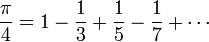
2. Here's one an Indian did write up in the 15th century AD:
and so on... FOREVER!!!


Pretty damn awesome. INFINITE SERIES RULE!!!
Good work Madhava of Sangamagrama! It would take until the 17th century for the series to be rediscovered through the hearty work of James Gregory and Gottfried Leibniz.

3. And if you like your arctangents (and who doesn't?), how about this def. of pi:


Kudos John Machin!

And if you don't like your arctans, well,
and so on, still FOREVER!!!
At least according to a nice little Taylor expansion of arctangent.

4. Well, to take Pi to the next level, another Indian had to get into the game. And so in the early 19th century another Indian did (actually Indians had been working all along, but this 5 def.s not a total history). I'm talking about the one, the only Srinivāsa Rāmānujan!!!
Check out his method for finding Pi, derived from the highest halls of Number Theory:


While that method didn't hit the big time till 1985, in that year William Gosper used it to calculate Pi to 17 million digits. Dude, sweet.

5. But if you want to go a little ways by the abstract route. Well, remember that Euler with some Taylor formulization of e^(ix), sin x and cos x, came up with

which when x = pi leads to a nice little identity involving pi:


Ah, Euler, you may have lived in the 18th century and pronounced your name like a greaser, but you're still one of the best.

So in conclusion let me give you one more def. of pi:

Pi = Awesome

Exactly

Tuesday, January 29, 2008

Mathimoto Speaks!!!

I, Rand McRanderson, on behalf of Mathimoto, man of math, air his complaint: People do not know enough about math!!!

And thus, I have been commanded to share with the people the world of math!!!

So stay tuned for:

Math History
Mini-math Lessons
Cool Math Facts
Math News

And MATH ULTRA-AWESOMENESS!!!

Math rules!!!

Thursday, July 5, 2007

The Logician's Dilemma

I am a man who likes to invoke logic. It often clarifies arguments a great deal and sometimes it is one of the few available methods of resolving a particularly bitter dispute between people of very different systems of thought. Yet I must make a confession. I am DB Cooper (I'm sorry Adam West, but somebody had to take the fall). But also I don't really like formal logic. I like logic in general, but I mostly just use the basic largely intuitive semi-logic. I realize that the problem with using that kind of logic is that it is inpercise, it tends to make overgenerous assumptions and it sometimes takes unwarranted logical jumps. But the advantage of intuitive semi-logic is that it is simpler, easier, and shorter. Formal logic is a different beast. It is a beast I respect, that I admire, but which annoys me if I'm around it for too long.

Formal logic is something that starts at the basics then marches up bit by bit to the end. Good idea if you want to be right. Bad idea if you're lazy or with little patience (I happen to have both qualities and I'm so incredibly awesome it doesn't matter if I'm wrong every now and then). Semi-logic might get you the wrong answer sometimes but it is quick and that means it allows me to solve a problem before I lose interest in it and it's good in a debate because its easy to explain in English (formal logic has its own language, and if I'm going to learn another language, well it's going to be this, but that's only because I'm taking a class about it, but I'm only taking a class that sort-of-half-assed teaches it (nothing against the teacher, but that's just the nature of the class)), also in an arguement one often lacks the time and scratch paper to work out a formal logic proof. But perhaps most usefully, the semi-logic is, as I have labelled it before, intuitive, which means that it can often work with your sub-conscious which is good since your sub-conscious tends to usually undermine your logic attempts.

I realize there is a sort of pure beauty to formal logic, but I only can catch it in glimpses. I can say wow look at how these things interconnect and make sense sometimes but most of the time I'm like huh? (confused) or buh? (mildly annoyed or bored). Those who can see the pure beauty of formal logic, they are the smart ones, they are the lucky ones, but they aren't the everybody ones and they aren't me. But still we ought to remember to give them some respect (not too much respect because the beauty of logic can sometimes blind people to their mistakes and also you don't want to inflate their heads too much) and we got to raise a glass to them. Cheers!

So take it to your head, take it to your heart and remember Rand rocks!

Saturday, May 5, 2007

Studying the math

Something makes it uncomfortable studying math. It's a subject that I'm pretty good with, enough so that I'm a minor and I have done decently well in most of my math classes. And yet there's an oddness with math. It seems like something out of my range, but then again I have moments when I become obsessed with the beauty of mathematical logic. And then there are other moments when the whole things seem stale, unknowable, and mysterious. The latter moments tend to seize me most in times like this when I'm trying to study and it feels like hitting my head against the wall. The former moments tend to come to me when I'm doing actual problems and start to understand things and speculate about other prospects. And yet it feels like more and more the moments of understanding and beauty have become rarer and rarer and I've got to wonder if I can take another year of high-level math. But I've gone this far in my college career with a math minor and it would be hard to do differently, anyways time and time again my mind has proven itself able to figure things out or at least memorize what I need to know to get by, even if I do get uncomfortable at times. So I've got to do what I got to do and I've got to study and hope that I can get those moments of understanding and maybe even a glimpse of the beauty that is the seamless logic of math.